









Introduction
Crowd size alone has never determined the success of the Alhambra. The evening experience proves that point better than anything else. Visitors who reserve a night entry are not paying for bigger crowds or longer routes. They are paying for atmosphere, careful visitor management, and the rare opportunity to experience one of Spain’s greatest monuments in a quieter setting. That is why alhambra palace night tour attendance revenue deserves attention from travelers, tourism professionals, and anyone interested in cultural heritage. The available official attendance figures show that night access remains intentionally limited, while public financial reporting confirms that ticket income supports the preservation and operation of the monument rather than simply increasing visitor capacity.
Why the Alhambra limits night tours instead of expanding them
The Alhambra is one of Europe’s most celebrated historic sites, and every decision about visitor access has long-term consequences.
Unlike modern attractions that can increase capacity by extending opening hours, the Alhambra must protect centuries-old architecture, decorative plasterwork, wooden ceilings, marble surfaces, gardens, and historic pathways. Every additional visitor creates physical pressure on spaces that cannot simply be rebuilt.
That reality shapes alhambra palace night tour attendance revenue more than any marketing campaign. Evening visits remain limited because preservation comes first. Restricting access protects the monument while creating a calmer experience for visitors who secure tickets.
It is a strategy built around sustainability rather than volume.
Official attendance data provides useful insight
The Alhambra consistently attracts well over two million visitors in a normal tourism year, placing it among Spain’s most visited cultural landmarks.
Official historical reports also show that evening attendance represents only a small portion of total admissions. One published report recorded approximately 65,297 visitors for Nasrid Palace night visits during 2014, while daytime admissions approached two million visitors during the same period.
Those figures explain why alhambra palace night tour attendance revenue cannot be judged by visitor numbers alone.
Night tours are designed to remain exclusive rather than compete with daytime capacity.
That controlled approach protects both the monument and the visitor experience.
Why separate night-tour revenue is not officially reported
People searching for exact earnings often expect a single published figure.
The official reporting does not work that way.
The Alhambra publishes transparency information, visitor statistics, and broader financial reporting, but it does not normally release a separate annual revenue total dedicated only to night tours.
This distinction is important when discussing alhambra palace night tour attendance revenue.
Independent websites sometimes estimate potential revenue using ticket prices and attendance figures. Those calculations can provide rough context, but they should not be treated as official financial data.
A responsible analysis separates verified information from estimated figures.
Ticket income supports preservation as well as tourism
Every ticket purchased contributes to more than a single visit.
Revenue generated through admissions helps finance conservation projects, restoration work, visitor facilities, security, maintenance, cultural programming, research, and daily operations across the monument.
Historic buildings require continuous investment.
Stone surfaces weather naturally.
Gardens demand year-round care.
Historic interiors require environmental monitoring and specialist restoration.
For that reason, alhambra palace night tour attendance revenue should be viewed as part of a wider conservation model instead of a simple tourism statistic.
Protecting heritage is an ongoing commitment rather than a one-time project.
The evening experience creates a different kind of demand
Visitors rarely choose a night tour because they expect to see more locations.
They choose it because they expect to experience the monument differently.
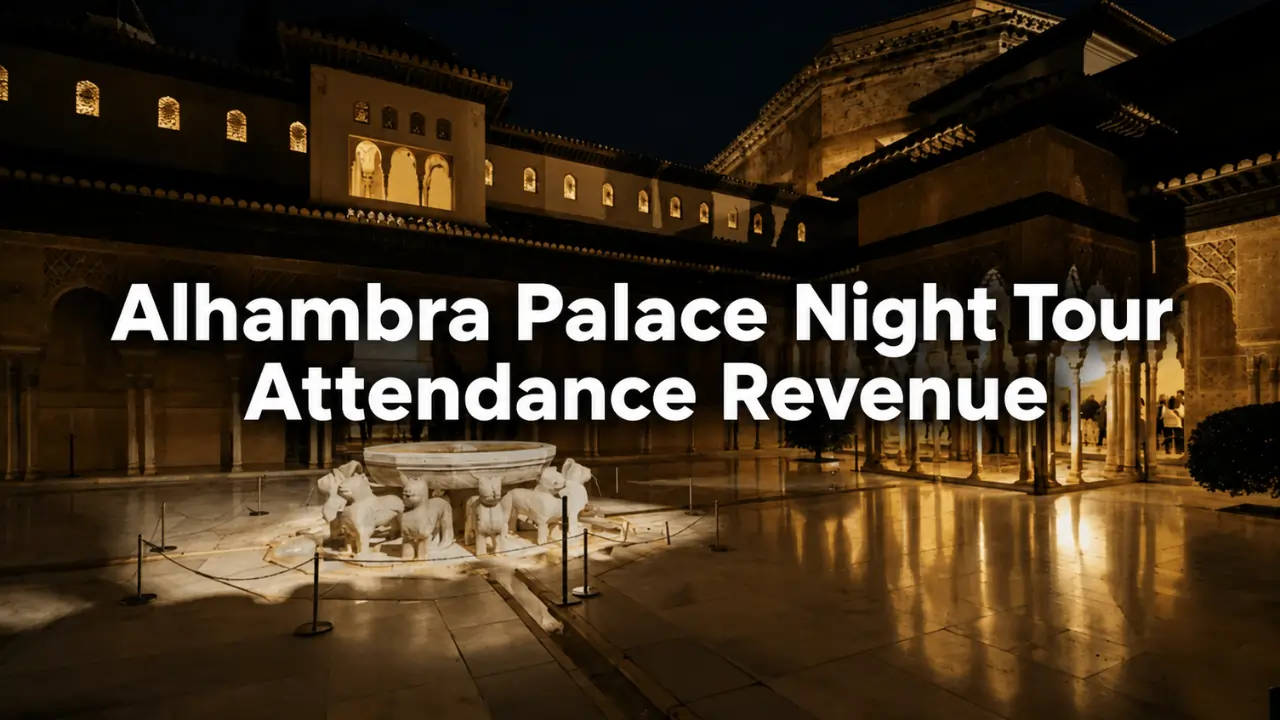
As daylight fades, carefully planned lighting transforms the Nasrid Palaces and surrounding spaces into a quieter environment. Visitor numbers remain low enough to allow slower movement through the historic complex.
This atmosphere cannot exist without attendance limits.
That relationship explains why alhambra palace night tour attendance revenue continues attracting interest despite restricted availability.
Scarcity alone does not create value.
The quality of the experience does.
Granada benefits beyond ticket sales
The economic effect of evening tourism reaches far beyond the entrance gates.
Travelers attending a night visit frequently extend their stay in Granada instead of making a quick day trip.
Hotels benefit from overnight bookings.
Restaurants welcome guests before or after scheduled entry times.
Local cafés, transport providers, and independent shops also benefit from visitors spending additional hours in the city.
Viewed from a wider perspective, alhambra palace night tour attendance revenue represents only one part of the financial contribution generated by evening tourism.
The surrounding local economy receives lasting benefits whenever visitors remain in Granada longer.
Attendance limits improve the visitor experience
Large crowds can reduce the enjoyment of even the world’s greatest landmarks.
Restricted evening admissions create quieter courtyards, shorter queues, improved photography opportunities, and more space to appreciate architectural details.
Visitors are less likely to feel rushed.
The monument itself becomes the focus rather than the crowd.
These qualities explain why demand for evening tickets often exceeds supply.
Instead of increasing capacity dramatically, the Alhambra continues prioritizing preservation and visitor satisfaction.
That decision has strengthened the reputation associated with alhambra palace night tour attendance revenue over time.
Revenue estimates should always be treated carefully
Because separate night-tour revenue figures are not officially published, any calculation depends on assumptions.
Ticket prices change over time.
Discount categories affect income.
Operational costs differ across seasons.
Special events and temporary policies also influence financial performance.
Without complete official financial disclosure, no outside calculation can be described as an exact annual revenue figure.
Acknowledging those limits produces a more reliable discussion than presenting estimates as confirmed facts.
The future of evening tourism at the Alhambra
Demand for carefully managed cultural experiences continues growing.
Digital reservation systems, timed entry, and controlled visitor flows allow managers to protect the monument while maintaining public access.
Future improvements are likely to focus on visitor management rather than increasing attendance dramatically.
That direction supports the long-term balance between conservation and tourism.
It also reinforces why alhambra palace night tour attendance revenue remains closely connected with responsible heritage management instead of mass tourism.
Final thoughts
The strongest measure of success at the Alhambra is not how many people enter after sunset. It is how effectively one of the world’s most remarkable historic sites continues welcoming visitors without compromising its future. The available attendance data, conservation priorities, and financial reporting all point in the same direction: careful management has become the monument’s greatest strength, and that approach gives lasting value to every evening visit.
FAQs
1. Does the Alhambra publish a separate annual revenue figure for night tours?
No. Official reports provide visitor statistics and broader financial information, but they do not normally separate annual revenue generated only from night tours.
2. Why are Alhambra night tours limited?
Attendance is restricted to help protect historic architecture, improve visitor comfort, and reduce pressure on sensitive areas of the monument.
3. How many people attend Alhambra night tours?
Official historical data recorded approximately 65,297 visitors for Nasrid Palace night visits during 2014. Overall attendance varies from year to year according to management policies and tourism demand.
4. How does ticket revenue benefit the Alhambra?
Admission income supports conservation, restoration, maintenance, visitor services, security, cultural programs, and day-to-day management of the historic complex.
5. Why is the evening experience different from a daytime visit?
Lower visitor numbers, carefully designed lighting, and a quieter atmosphere create a more intimate way to experience the monument while helping preserve it for future generations.
Read More: Inter Miami vs Tigres Uanl Timeline: Complete Rivalry Guide With Match History and Key Moments